



Digital Transformation Canada Needs to Start Fresh - new op-ed in The Hill Times
Machinery-of-government changes often create the appearance of reform while leaving the rules, contracts, and leadership of the old institutions intact.
In The Hill Times, I argue that if the recently launched Digital Transformation Canada is going to succeed at finally modernizing the federal government for the digital age, it must be treated not as a merger of existing organizations, but as the founding of a new institution with a mandate to drop the rules, processes, practices, and importantly, the custodians, of the old order.
****
Digital Transformation Canada Needs to Start Fresh
September 16, 2026
The Government of Canada has launched Digital Transformation Canada, merging teams from five departments under former Google executive Patrick Pichette to change how government develops, buys and uses technology.
This is both a significant opportunity and a dangerous moment. Machinery-of-government changes can create the appearance of reform while leaving the rules, contracts, incentives and leadership of the old institutions intact. The result is a new organization that behaves exactly like its predecessors, one more costly reform confirming fears that government cannot improve.
To avoid this risk, Pichette should treat Digital Transformation Canada as the founding of a new institution with a mandate for deep public administration reform.
Begin with subtraction
Most transformations prioritize additions: strategies, governance bodies, executive roles and, ini the case of Digital Transformation Canada, a fellowship program. Less attention goes to what should end. Pichette should start there. Rules that generate paperwork without reducing risk, and reviews that repeat decisions made elsewhere, should go. So should executive layers that separate decision-makers from delivery, and briefing practices that leave leaders exhaustively informed yet unable to act. Every inherited function, process and executive position must earn its place.
Digital Transformation Canada will fail if Pichette simply divides responsibilities among the inherited leaders, who will default to what they know. Begin instead with the mandate, set the operating model, then choose the people equipped to lead. Follow the State of Colorado’s example: they published their strategy and let go of people who no longer fit the model.
Pichette’s initial calendar will be telling. If the next three months go to inherited executives defending their functions and competing for dominance, the old organization has already won.
Take big swings, especially on procurement
Reopen supposedly immovable decisions: exit contracts that no longer deliver, consolidate duplicative platforms, replace document-based controls with automated guardrails. Change carries risk, but so does the status quo.
Procurement belongs at the centre of the new organizational mandate. My co-authors and I have shown, using the government's own data, that federal IT contracting routinely violates best practice: lengthy procurements that favour incumbents, bundled work that shuts out smaller firms, vendor-owned intellectual property that locks in products that no longer serve the public, and eroded expertise that leaves government unable to hold suppliers accountable. Parliament, the Auditor General and every Phoenix and ArriveCAN post-mortem agree. And yet, these bad habits persist.
Modular contracting should replace enormous, long-term agreements. Automatic extensions should end and IT spend controls begin. Open standards and reuse should be defaults; publicly funded technology should stay public. Every inherited contract faces one test: knowing what we know now, would we sign it today?
Recruit nationally and bring back the doers
Over the past decade, government recruited people with strong digital skills who challenged administrative policy and delivery norms in the name of better services. The institution frustrated and lost them. That they struggled in the old model is exactly what makes them valuable to the new one. Pichette should find them and ask what happened. Their answers are worth more than another briefing from those who inherited the system.
He should also look beyond Ottawa. Canada's digital talent is spread across the country; a digital organization built around "in person in the capital" excludes most of it. Government competing for scarce skills must meet talent where it is.
Leaders will need real fluency in modern delivery practices, and fellows should be judged by the public capacity they leave behind. Otherwise government will again rent the expertise it has repeatedly failed to keep.
Use this founding moment
There will be a natural tendency to measure Digital Transformation Canada by what it announces: strategies, partnerships, shiny products and uses of artificial intelligence. Doing these will be easier than confronting the organization’s inheritance. Pointing new technology at old government problems is a fool's errand; real transformation attacks the conditions that produced those problems in the first place.
We should measure this organization first by what it stops. Which rules disappear? Which approvals go? Which contracts are exited? Which leaders are asked to seek a new mission because the institution they sustained is the one being replaced?
The federal government has tried digital transformation before. This time, it has created an organization with transformation in its name. Earning that name will require the courage to leave parts of the old model, and some of its custodians, behind.


New paper on federal government IT contracting
In 2022, Sean Boots and I, supported by two research assistants at Carleton University (Chantal Brousseau and Anne Lajoie), launched govcanadacontracts.ca, an open access research tool to help people more easily explore the Government of Canada’s proactively disclosed data on federal contracting. It’s been super rewarding to see how the tool has been used, and in particular, to use this work to support ongoing (and very welcome) public inquiry into federal Information Technology (IT) contracting and reliance on management consultants.
The tool and the research findings our team has drawn from it have been covered by iPolitics, Politico, the CBC news podcast Frontburner, and highlighted in analysis by journalist Paul Wells. Former Clerk of the Privy Council Michael Wernick endorsed the tool as “exactly the kind of initiative [Treasury Board] Minister Brison had in mind when he pushed forward open government and open data.” Sean and I were also invited to deliver expert testimony at two parliamentary studies of federal government contracting (including the inquiry into the ArriveCAN app) by the Standing Committee on Government Operations and Estimates, where we submitted the recommendations we outline in A Guide to Reforming Information Technology in the Government of Canada.
Today I’m happy to share the academic paper we developed using the tool (it’s still under peer review, so we share it now with that caveat!). In the paper we explain the role that IT procurement plays in supporting (or more often, preventing) digital government transformation, draw on international experience to outline a set of ‘rules’ for modern public sector IT contracting, and then assess the extent to which the Government of Canada adheres to these rules.
The punchline is – the federal government breaks almost all globally accepted best practice for modern public sector IT procurement, a reality which we argue helps explain why we have scandals like the ArriveCAN debacle that’s still unfolding. More importantly, we argue that unless we reform federal IT procurement so that it gets up to speed with widely accepted best practice in the field, any attempts to drive forward meaningful digital reform in the Government of Canada are bound to fail.
We’re eager for any feedback others have on the paper, and hope that it’s useful to those that are working hard right now to try and reform federal IT procurement, and push forward digital government reform in Canada more broadly. Many of these public servants offered incredibly useful feedback on earlier drafts of the paper, contributions that we were so grateful to receive.

Protecting Public Advice: New report with the Royal Society of Canada
In the past year I've been working with the Royal Society of Canada (RSC) as a member of the Working Group on Protecting Public Advice within the RSC's Task Force on COVID-19. In February my co-authors (Julia Wright, Wendy Hui Kyong Chun, Matthew Herder and Howard Ramos) and I published our final report, which has also been accepted for publication as an article in FACETS.
The report focuses on the threats and risks that researchers face when they step into the public domain to share their research and provide advice to policymakers and the general public, especially in the context of today's chaotic, competitive and combative information ecosystem. We make a series of recommendations to help address this problem, focusing on the need to better measure the problem and on the importance of developing easy to access supports for researchers who are threatened. Most importantly, we call on researchers, those that fund and govern them, as well as the general public, to engage in conversation about what we hope to achieve from scholars' public engagement, and how to achieve these objectives without jeopardizing the safety of researchers.
The full report is available here.
We also did a webinar to discuss our findings.
And, we wrote an op ed summarizing our argument in the Globe and Mail.
It was an absolute pleasure to co-author this work with the Royal Society and with such an insightful and engaged interdisciplinary group of scholars. I look forward to pushing ahead the policy changes we recommend in our study.
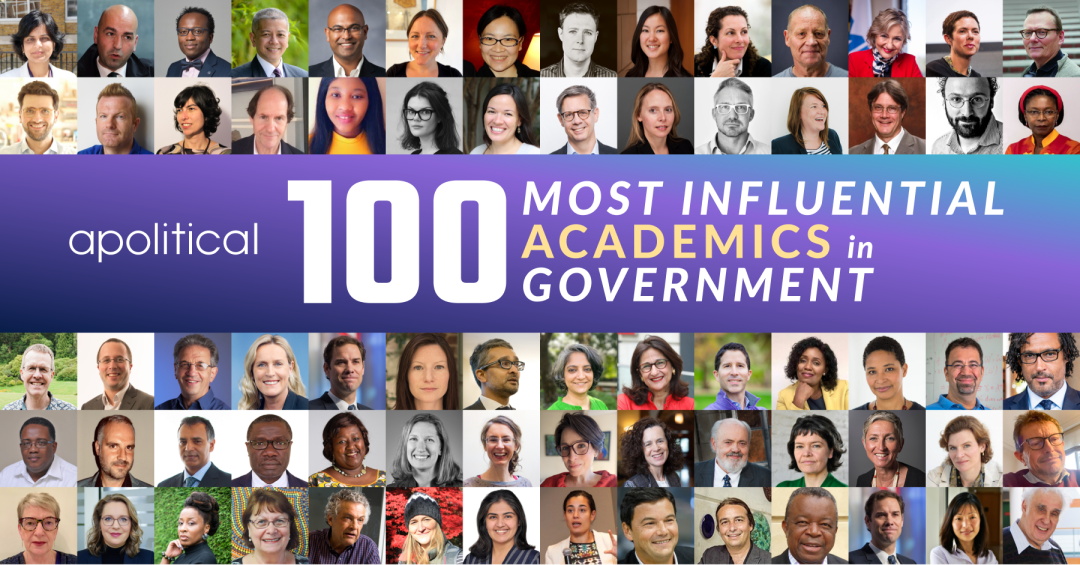
Included in Apolitical's Top 100 Most Influential Academics in Government
In December 2021, Apolitical released their list of the Top 100 Most Influential Academics in Government. I was thrilled to be included, especially alongside all of the other fabulous researchers celebrated in the list.

Teaching Public Service in the Digital Age: A Briefing For Potential Research Collaborators
Over the past year I’ve helped lead a new Research Workstream within the international teaching collaboration, Teaching Public Service in the Digital Age.
To initiate the Research Workstream, Tom Steinberg and I co-authored a Research Briefing, which outlines the key research questions that we think need to be answered to test and refine what have become widely accepted – but rarely empirically scrutinized – best practices in digital era government.
We’re also launching a series of Research Workshops in 2022. These workshops will bring together an international group of researchers to share and discuss research papers and to identify opportunities for collaboration.
You can read the Research Briefing here.
If you would like to apply to attend the Research Workshops, you can do so here.
Citation: Clarke, Amanda & Tom Steinberg. 2021. Teaching Public Service in the Digital Age: A Briefing for Potential Research Collaborators. November 2. pp. 12.
How can governments better collaborate with civic technologists?
Today I participated in a fascinating conversation hosted by MySociety on the topic of public-private partnerships in civic tech. Civic tech practitioners discussed the challenges they face when trying to work with government, including the mismatch between agile design processes and government budgeting and policy cycles, the inflexibility of government approval processes and departmental silos, and dated and overly onerous public procurement processes. For my part, I brought to the conversation an appreciation for the historical patterns that predated and set the stage for dysfunctional public-private partnerships in the tech space. I also laid out a series of promising research avenues that will help us improve how governments and civic technologists partner going forward.

New book review: Take a Number: How Citizens’ Encounters with Government Shape Political Engagement
I reviewed Prof. Elizabeth Gidengil’s latest book, Take a Number: How Citizens’ Encounters with Government Shape Political Engagement (McGill-Queen’s University Press) in the Canadian Journal of Political Science. You can read the full review here (paywall).
The book reports on the first comprehensive study to investigate policy feedback effects in Canada and has a number of particularly notable findings. First, policy feedback effects operate quite differently in Canada than they do in the US (which has a much more developed feedback literature, one that Gidengil’s study reveals can’t simply be ported over to help us understand the Canadian case). Second, the study suggests that public service experiences have a strikingly significant impact on political participation, especially for women. Third, at least in the case of the Ontario services included in the study, the book suggests that many public services are failing citizens, either because they leave their users dissatisfied, or because those most in need of these services struggle to identify and access them.
I would put this book on the reading list of anyone interested in political behaviour and attitudes in Canada. I also think its findings on service quality deserve the attention of today’s policymakers, who for the most part continue to design and manage government using the dated playbook that produced the under-performing public services Gidengil brings to light.
Citation: Clarke, A. (2021). Take a Number: How Citizens’ Encounters with Government Shape Political Engagement. Elisabeth Gidengil, Montreal and Kingston: McGill-Queen’s University Press, 2020, pp. 248. Canadian Journal of Political Science, 1-3. doi:10.1017/S0008423921000809

One year into the pandemic, federal digital government is largely business as usual
It’s been a year since the COVID-19 pandemic forced the federal government to make the sudden shift to working from home and to expand its online service offerings. What difference, if any, did this make for ongoing efforts to renew the federal government for the digital age?
I asked this question to a group of federal public servants and reported on what they told me in a brief analysis published today in Policy Options (and subsequently in The Ottawa Citizen). The short answer: the pandemic hasn’t fundamentally changed how the federal government operates and digital government reform remains an exhausting uphill battle.
Review of Opening the Government of Canada in the Canadian Journal of Political Science
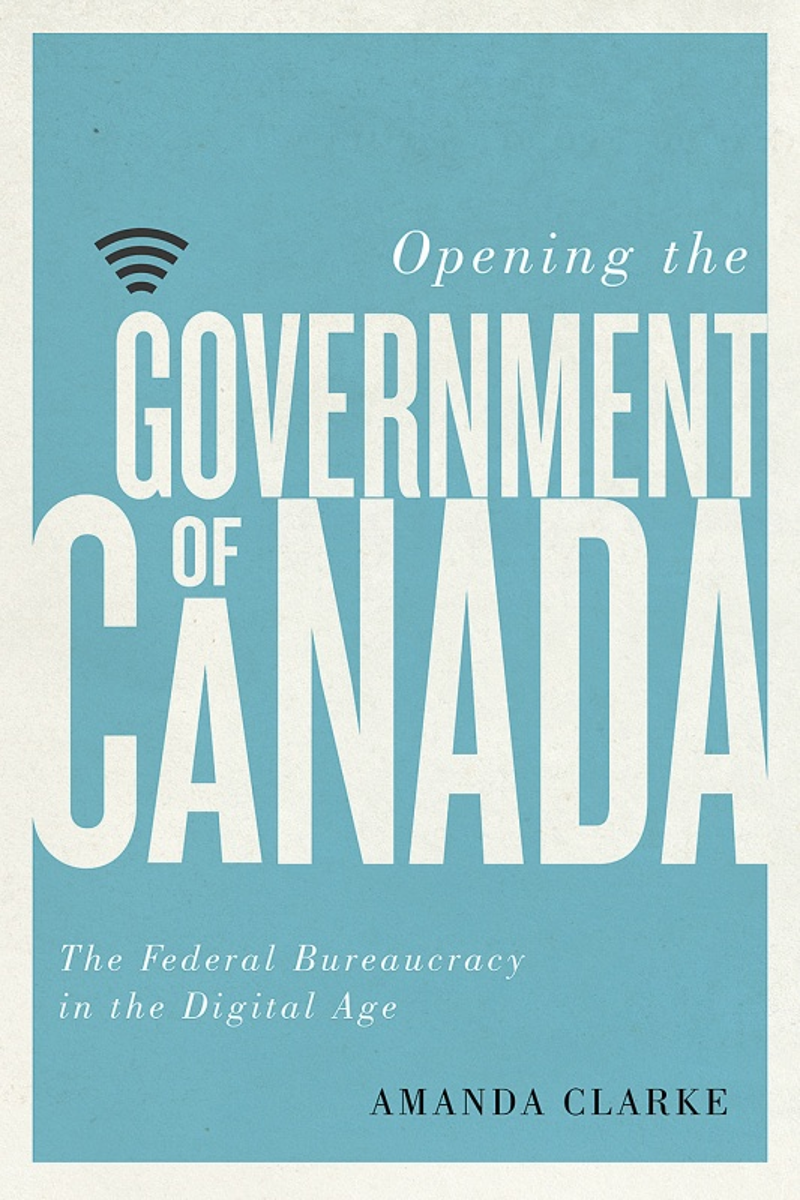
Prof. Andrea Rounce published a review of my 2019 book, Opening the Government of Canada, in the latest edition of the Canadian Journal of Political Science. The full review is below and available on their site here.

Data Governance: The Next Frontier of Digital Government Research and Practice
Elizabeth Dubois and Florian Martin-Bariteau have put together a great collection of chapters focused on Canadian citizenship in the digital age in their new edited collection, Citizenship in a Connected Canada. I contributed a chapter that identifies gaps in research and policy on public data governance in Canada. The abstract is below, and the entire book is available for purchase or as an open access download here.
Abstract:
Picking up on a global orthodoxy calling for digital government transformation, governments across Canada are now introducing ambitious service reforms and broader changes to the organization and culture of public service institutions. These reforms are primarily justified on the grounds that they are necessary if governments wish to meet the expectations of citizens accustomed to the innovative digital service offerings of the private sector. Yet with digital transformation agendas come notable changes to the ways that public sector data is collected, applied, and shared across the state and amongst private firms. These data governance reforms may prove unacceptable to citizens where they lead to privacy breaches, betray principles of equity, transparency and procedural fairness, and loosen democratic controls over public spaces and services. This chapter presents three cases that illustrate the data governance dilemmas accompanying contemporary digital government reforms. The chapter next outlines a research and policy agenda that will illuminate and help resolve these dilemmas moving forward, with a view to ensuring that digital era public management reforms bolster, rather than erode, Canadians’ already precarious levels of trust in government.
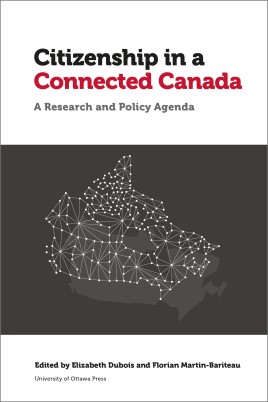
Citation: Clarke, A. 2020. “Data Governance: The Next Frontier of Digital Government Research and Practice” in Citizenship in a Connected Canada: A Research and Policy Agenda for Digital Citizenship. Elizabeth Dubois and Florian Martin-Bariteau, eds. Ottawa: University of Ottawa Press, pp. 97-117.